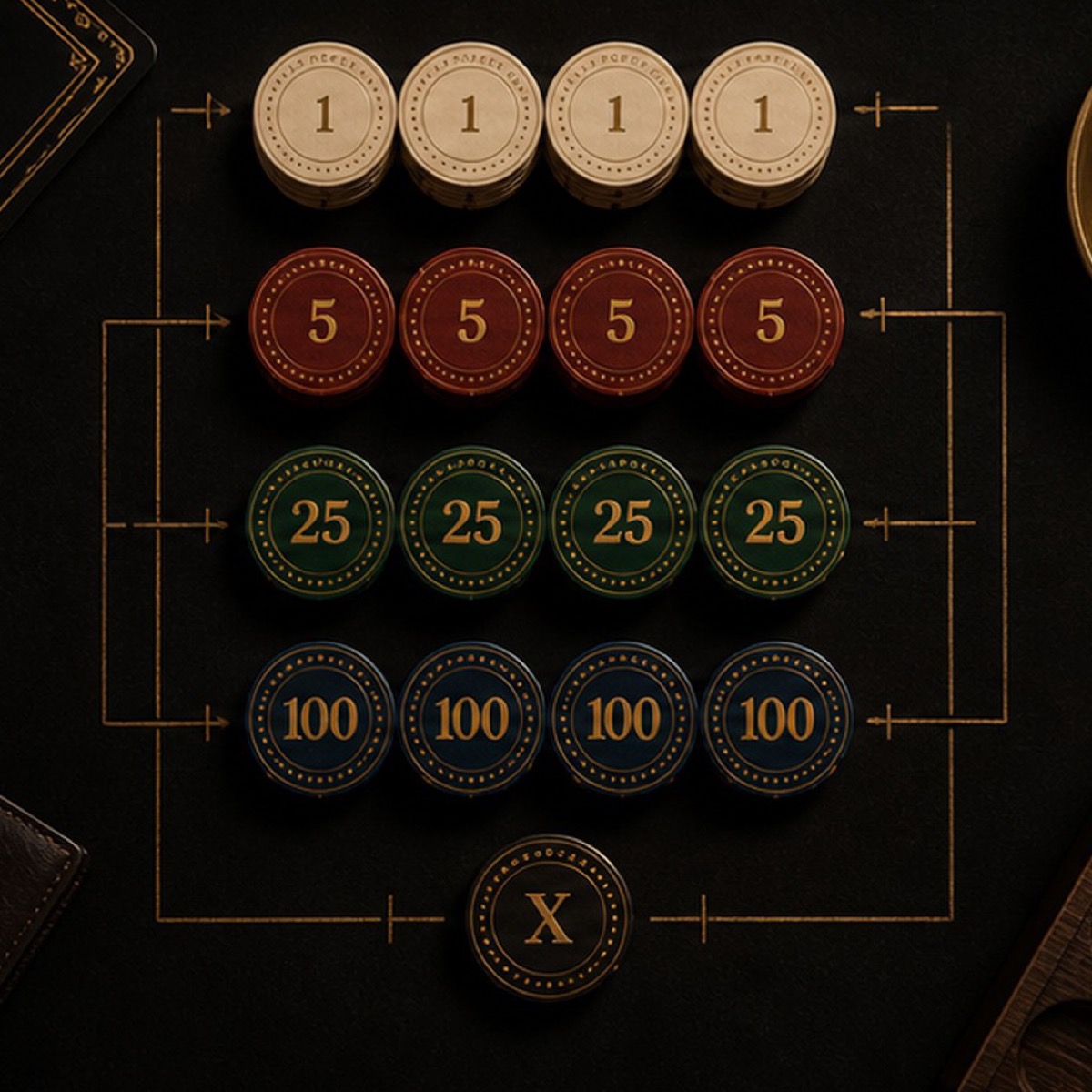
For most private home cash games, use poker chip denominations of 1, 5, 25, and 100. Add a 500 chip when the game plays deep or allows frequent rebuys. For home tournaments, use wider values such as 25, 100, 500, 1000, and 5000 so blind increases and color-ups stay manageable.
| Game type | Useful denominations | Why they work |
|---|---|---|
| Low-stakes cash game | 1, 5, 25, 100 | Easy blinds, small bets, change-making, and simple rebuys. |
| Deeper cash game | 1, 5, 25, 100, 500 | Keeps larger pots and late-night stacks compact. |
| Home tournament | 25, 100, 500, 1000, 5000 | Supports larger starting stacks, rising blinds, and color-ups. |
Start with the game format
Cash games and casual tournaments need different chip logic. A cash game should map cleanly to buy-ins, blinds, and rebuys. A tournament set should make starting stacks easy to count and allow blind increases without constant change-making.
That distinction matters because a cash-game chip can represent money or an agreed house value, while a tournament chip usually represents points. If you use tournament denominations for a small cash game, players may struggle to make blinds and change. If you use tiny cash-game values for a tournament, the table can become cluttered after only a few blind levels.
Why 1, 5, 25, and 100 work well
These values are easy for most players to understand because each step is useful at the table. The 1 chip handles blinds and small change, the 5 chip handles most common bets, the 25 chip cleans up medium pots, and the 100 chip keeps larger stacks compact.
| Denomination | Best use at a home table |
|---|---|
| 1 chip | Small blind unit, limps, small calls, and making change. |
| 5 chip | Main workhorse chip for common bets and raises. |
| 25 chip | Medium pots, larger raises, and keeping stacks readable. |
| 100 chip | Deeper stacks, larger rebuys, and faster counting. |
| 500 chip | Only needed when the table plays deep enough to justify a top value. |
When to add a fifth denomination
A fifth chip is helpful when your home game has larger buy-ins, frequent rebuys, or a table that plays deep for several hours. The fifth value should reduce stack clutter, not replace the chips people touch every hand. If adding a 500 chip forces you to cut too many 1 or 5 chips, the set may look bigger while playing worse.
Quick check: if the smallest two denominations disappear from the bank before the first rebuy, the denomination mix is too top-heavy. Protect the low and middle chips before adding more high-value chips.
Example 500-chip denomination plan
A 500-chip set should not split every color evenly. Home games usually need more low and middle values than top values because blinds, calls, and making change happen constantly. Use the table below as a planning model, then adjust for your exact blinds and buy-ins.
| Denomination | Example count | Role |
|---|---|---|
| 1 | 150 chips | Small blinds, calls, and early change. |
| 5 | 150 chips | Main betting unit for regular pots. |
| 25 | 100 chips | Medium bets and stack consolidation. |
| 100 | 75 chips | Larger pots and deeper rebuys. |
| 500 | 25 chips | Top-end bank chips for deeper nights. |
For a tournament, keep the same planning principle but change the value ladder. A tournament version might use 25, 100, 500, 1000, and 5000, with lower values weighted toward early blind levels and higher values reserved for later color-ups.
Common denomination mistakes
- Using too many denominations, which slows down betting and counting.
- Not having enough low-value chips for blinds, antes, and small change.
- Buying a set before deciding whether the game is mostly cash or tournament play.
- Splitting every color evenly instead of weighting the values players use most.
- Choosing denominations that look official but do not match your actual blinds.
Where Tells fits
Tells Poker Club is building a premium 500-chip ceramic set for private home games, with 43mm chips, two boxes of poker cards, a dealer button, and a case. The set is meant for hosts who want a complete poker night setup rather than a generic tray of evenly split colors.
If you are comparing chip sets, look past the total chip count. The better buying question is whether the denominations, chip counts, cards, button, and storage all support the way your table actually plays.
FAQ
What are the best poker chip denominations for home games?
For most home cash games, 1, 5, 25, and 100 are the best starting denominations. Add 500 only when the game plays deep or uses larger rebuys.
Should cash games and tournaments use the same chip values?
No. Cash games usually need smaller, practical values that map to blinds and buy-ins. Tournaments usually use wider values such as 25, 100, 500, 1000, and 5000 because blinds rise and lower values can be removed later.
How many denominations should a 500-chip set have?
Most 500-chip home sets work best with four or five denominations. Four values are enough for many low-stakes cash games. Five values are better for deeper games, rebuys, and tournament-style setups.
Related reading
Pair this guide with the poker chip values guide, the chip count guide, and the 500-chip breakdown. If you are still deciding what kind of set fits your table, compare 300 vs 500 poker chip sets.