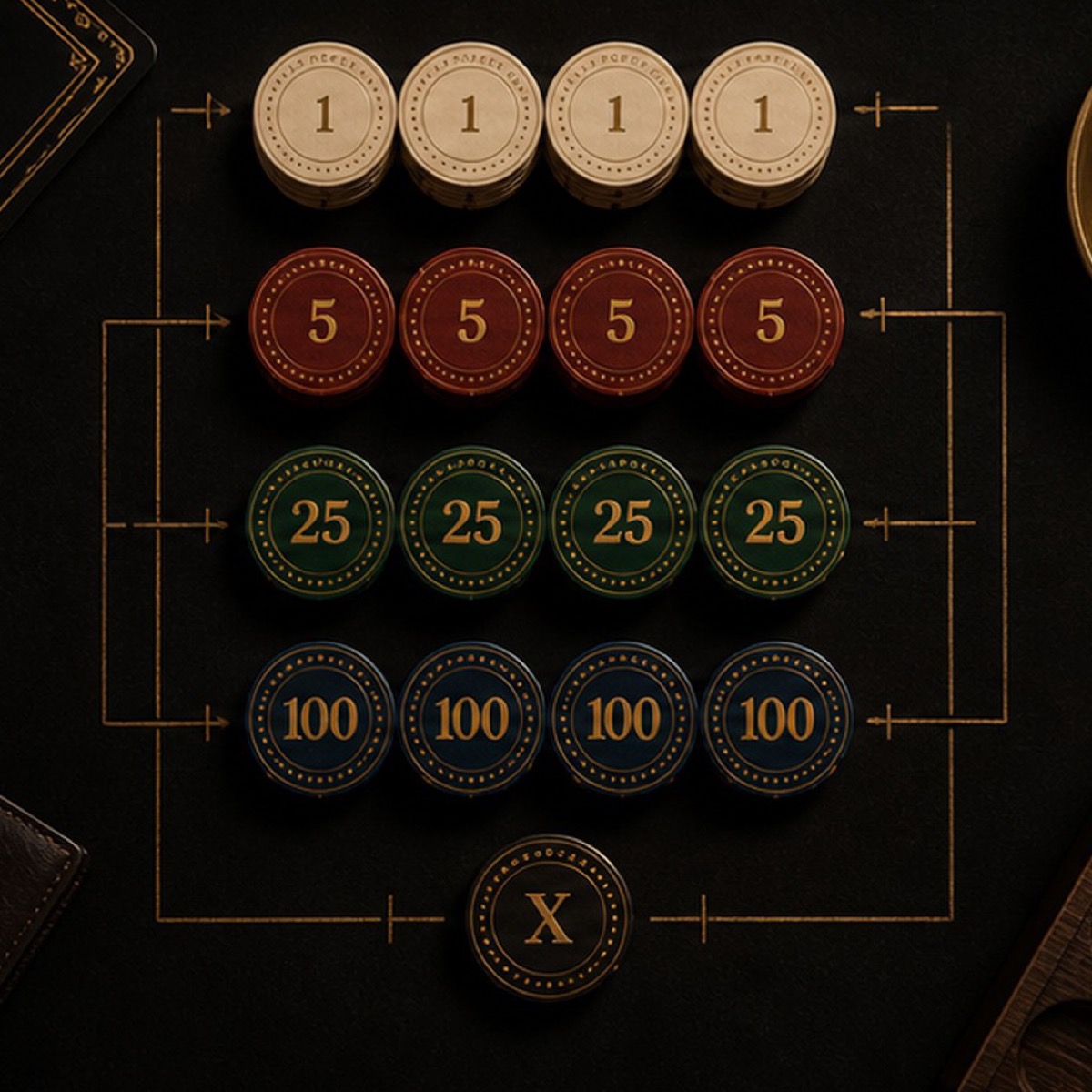
Poker chip colors are not universal. A common home-game ladder is white or blue for 1, red for 5, green for 25, black for 100, and purple or yellow for 500, but your table can assign different values. What matters is that every player can identify each color instantly.
| Chip color | Common home-game value | Best use |
|---|---|---|
| White or blue | 1 | Small blinds, limps, change-making, and low-value betting units. |
| Red | 5 | The workhorse chip for common calls, raises, and small pots. |
| Green | 25 | Medium pots, larger bets, and keeping stacks from spreading too wide. |
| Black | 100 | Deeper stacks, larger rebuys, and faster chip counting. |
| Purple or yellow | 500 | Only useful when the game plays deep enough to need a top value. |
Why chip colors are not fixed
Casino chip colors vary by venue, region, and event, and home games have even more flexibility. A white chip might mean $1 in one place, a small blind unit in a private cash game, or tournament points in a casual tournament. Do not ask guests to guess from color alone.
The cleanest home-game setup treats color as a readability tool. Pick values that match the game, then keep the same color-value map for the whole night. If a chip has a printed denomination, let the print lead and use color as a quick visual cue.
Cash game colors vs tournament colors
Cash games usually need enough low-value colors for blinds, small bets, and making change. A 1, 5, 25, and 100 ladder is easy for most private tables. If the game uses quarters or dollars, the same printed values can represent table units rather than literal dollars, as long as everyone agrees before play.
Tournaments usually need wider spacing because blinds increase. A simple tournament ladder can use 25, 100, 500, 1000, and 5000. In that setup, colors help players and the host identify which lower denominations should eventually be colored up and removed from play.
| Game format | Color-value goal | What to avoid |
|---|---|---|
| Low-stakes cash game | More low-value chips in colors players touch every hand. | Too many high-value colors and not enough change-making chips. |
| Deeper cash game | Add one top color for rebuys and large stacks. | Adding a 500 color before the table has enough 1s and 5s. |
| Home tournament | Distinct colors for each level of the blind structure. | Reusing a color for a new value without announcing the change. |
How many colors does a home set need?
Most regular home games need four or five colors. Four colors are enough for many casual cash games. Five colors help when your table has deeper buy-ins, frequent rebuys, or tournament structures that move through larger values. More colors can look impressive in the case, but they do not help if the set lacks the low denominations players actually need.
Before buying a set, decide which values will be busiest at the table. For many private games, that means protecting the lower end of the bank instead of dividing the case evenly across every color.
A simple home-game color checklist
- Choose values before players arrive, not during the first orbit.
- Use printed denominations when available so color is not the only signal.
- Keep high-value chips visible and separated from lower-value stacks.
- Do not change a color's value mid-game unless the whole table agrees.
- Weight the bank toward the colors used for blinds, calls, and change.
- Use a quick reference card or host note for new players.
Where Tells fits
Tells Poker Club is building a premium 500-chip ceramic poker set for private home games, with 43mm chips, cards, a dealer button, and a case. The product is designed around a complete table experience, so chip colors and denominations should make the game easier to host, not just fill a tray evenly.
If you are comparing chip sets, look for clear denominations, enough practical colors, and a format that fits the way your group actually plays.
Choose colors around the table you host
See the Tells 500-chip ceramic format, included cards, dealer button, case, and private-game positioning behind the first presale run.
Sources used for chip-color conventions and table-readability guidance: Poker.org's poker chip values and colors guide, Wikipedia's casino chip color notes, and Poker TDA chip visibility and countability rules.