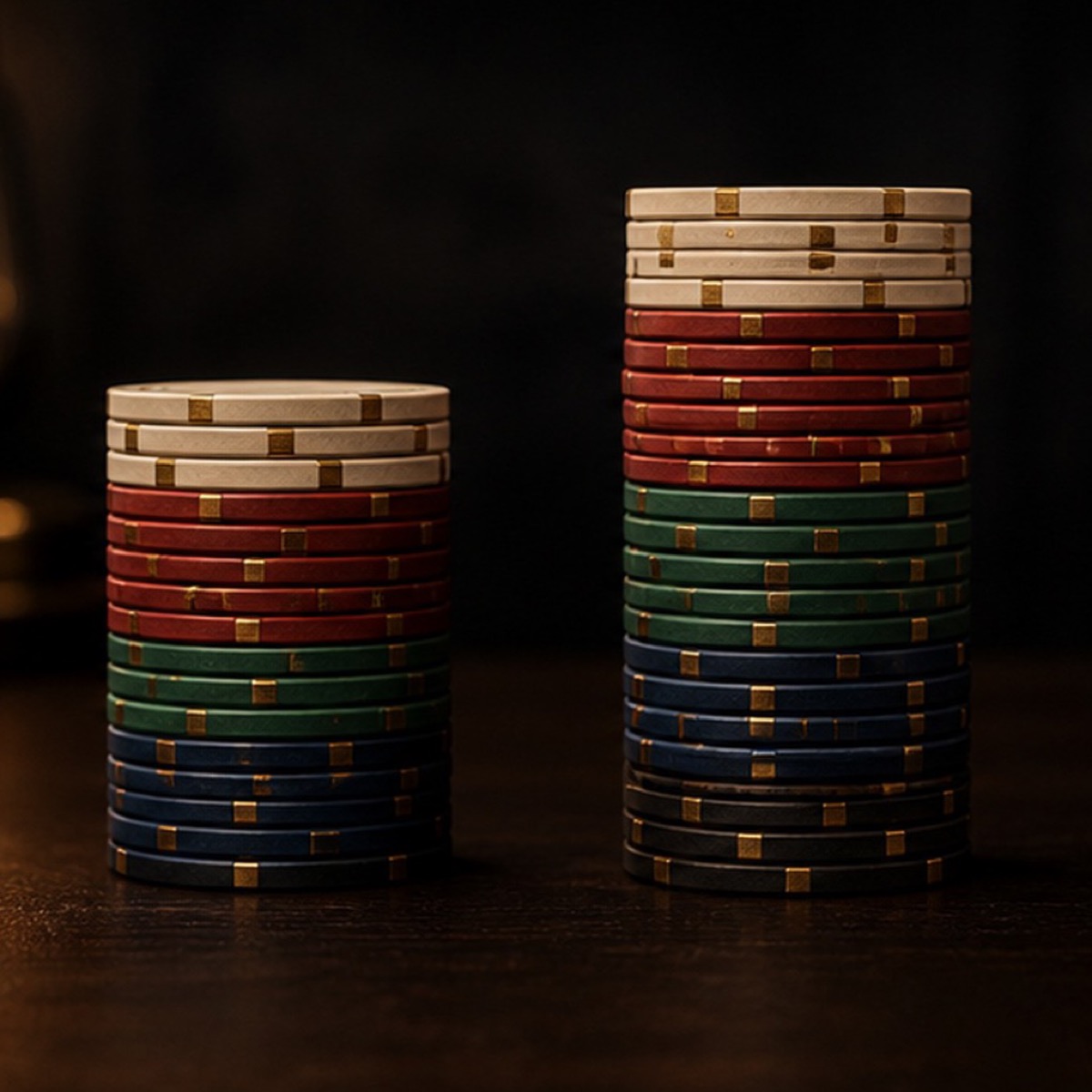
For a 500 chip cash game set, start with 150 chips at the smallest blind value, 150 chips at the main betting value, 100 chips at the next jump, 50 chips for larger pots, and 50 chips for rebuys. For many home games, that means 150 x 25c, 150 x $1, 100 x $5, 50 x $25, and 50 x $100.
| Best fit | Private cash games with 6 to 10 players and optional rebuys. |
|---|---|
| Main principle | Buy more low and mid values than high values because they move every hand. |
| Avoid | A flat 100/100/100/100/100 color split unless your group rarely rebuys. |
Pick the blinds before picking the chips
Cash-game chips represent money, so the set should start with the smallest blind or ante your group actually uses. A 25c/50c home game needs many quarter chips and plenty of $1 chips. A $1/$2 game needs more $5 and $25 chips because pots and rebuys get larger faster.
If your group changes stakes often, choose labels that can flex. A chip marked 25 can represent 25c in a small cash game, 25 in a tournament, or a fixed house value if everyone agrees before the first hand.
500 chip breakdown for 25c/50c
For a casual 25c/50c private game, low values matter most. Players need quarters for blinds and small raises, $1 chips for most betting, and $5 chips for larger pots. Higher values should mostly sit in the bank for rebuys.
| 25c | 150 chips for blinds, limps, small raises, and making change. |
|---|---|
| $1 | 150 chips as the main betting chip for a relaxed home table. |
| $5 | 100 chips for bigger pots and cleaner stacks after the game opens up. |
| $25 | 50 chips for rebuys, deeper stacks, and the host bank. |
| $100 | 50 chips only if your group rebuys often or wants compact bank chips. |
500 chip breakdown for $1/$2
For a $1/$2 private game, do not waste too much case space on $1 chips. The $5 chip becomes the workhorse, while $25 and $100 chips make rebuys and deeper stacks easier to manage.
| $1 | 100 chips for blinds and small change. |
|---|---|
| $5 | 200 chips because most bets and calls will use this value. |
| $25 | 100 chips for larger pots and common rebuy stacks. |
| $100 | 75 chips for the bank, deeper stacks, and late-night play. |
| $500 | 25 chips only if the game plays deep enough to need a top bank value. |
Starting stacks for each player
Put usable chips on the table at the start and keep oversized chips in the bank. For 25c/50c, a simple $50 starting stack can use 12 x 25c, 12 x $1, and 7 x $5. For $1/$2, a $200 starting stack can use 10 x $1, 18 x $5, and 4 x $25.
Those stacks are not rules. They are a clean starting point. Adjust the exact count if your group buys in smaller, plays deeper, or wants more small chips in front of each player.
Keep rebuys in the bank
The host does not need to put every chip on the table at the beginning. Reserve high-value chips for rebuys, add-ons, and making change. This keeps the table less cluttered and gives the host room to handle late arrivals without breaking stacks that are already in play.
How Tells Poker Club fits
Tells Poker Club is built around a complete 500-chip ceramic set for private home games. The presale format gives buyers a way to follow the first run while the denomination mix is tuned around real host feedback, not a generic five-color split.
The set includes 43mm ceramic chips, two boxes of cards, a dealer button, and a case, so the table feels intentional without asking the host to assemble a set from unrelated parts.
Related reading
For a broader overview of 500-chip sets, read the 500 poker chip set breakdown. If you are still choosing values, use the poker chip values for home games guide. If you are deciding what to buy, compare the poker chip set buying guide.