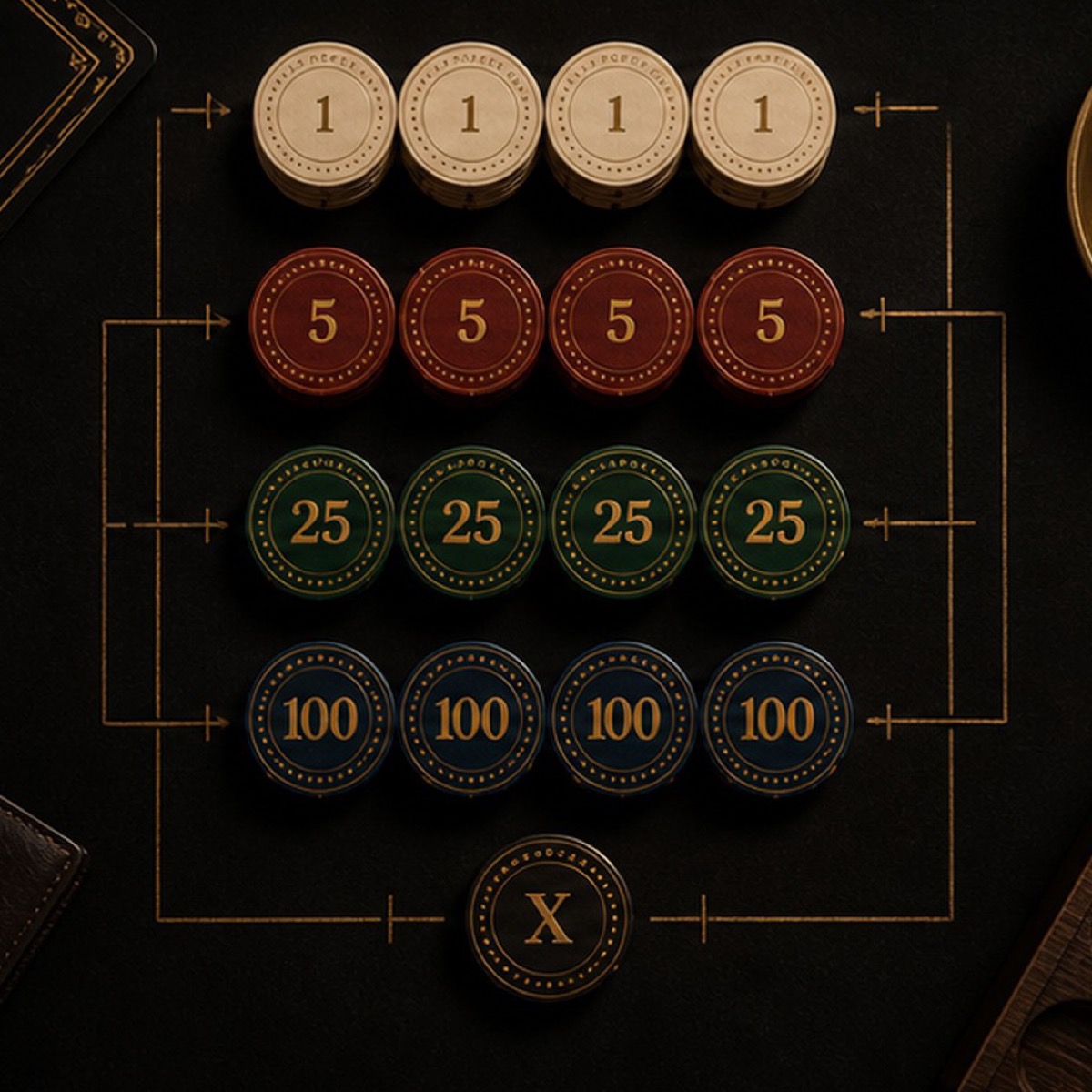
For most home cash games, use chip values of 1, 5, 25, and 100. Add a 500 chip only when your game has larger buy-ins, deep stacks, or frequent rebuys. For home tournaments, use point values such as 25, 100, 500, 1000, and 5000 instead of cash-game values.
| Casual low-stakes cash game | Use 1, 5, 25, and 100 for clear blinds, small change, and easy rebuys. |
|---|---|
| Deeper cash game | Add a 500 chip so larger stacks stay compact and rebuys do not eat your low values. |
| Simple home tournament | Use 25, 100, 500, 1000, and 5000 instead of cash-game values. |
Do poker chips have fixed money values?
Poker chips do not have a fixed cash value in a private home game. A red chip, blue chip, or 25 chip only means what the host and players agree it means for that night. The important part is that the value ladder matches the blinds and is announced before the first hand.
For cash games, the easiest approach is to make the smallest chip equal to the smallest betting unit you actually need. If your table plays 25c/50c, a 1 chip can represent one quarter unit, but printed 5 and 25 chips become harder to explain in dollars. Many hosts prefer cleaner dollar-based games, chips marked with cent values, or a simple house-value system so every stack is easy to count.
| Home-game setup | Simple value plan | Host note |
|---|---|---|
| 25c/50c cash game | Use cent-marked chips, or define 1 as one quarter unit before play. | Avoid making new players do conversion math at the table. |
| $1/$2 style cash game | Use 1, 5, 25, 100, with 1 representing $1. | The cleanest mental math for casual private games. |
| Casual tournament | Use 25, 100, 500, 1000, 5000 as points. | Do not cash out chips by face value after a tournament. |
Choose values from the game you actually host
Home poker hosts often start backwards. They buy a case first, then try to force their game into whatever values came with it. It works better to start with the game itself: what the blinds are, how many players usually show up, and whether people rebuy once or several times.
If your table is a relaxed cash game with modest blinds, you need a strong supply of low-value chips so betting feels smooth. If your game runs deep and players stay for hours, you also need a bigger value at the top end so stacks do not become tall and messy. That is why four or five practical values beat a decorative spread.
Best poker chip values for most home cash games
The most common private-game setup is still 1, 5, 25, and 100. Those values work because each step handles a different part of the night. The 1 chip covers blinds and small change. The 5 chip becomes the main betting unit. The 25 chip cleans up medium pots, and the 100 chip keeps larger stacks readable.
| 1 chip | Use for the smallest blind, small calls, and making change early in the game. |
|---|---|
| 5 chip | Usually the busiest chip on the table once the game settles in. |
| 25 chip | Useful for raises, medium pots, and reducing clutter in front of each player. |
| 100 chip | Useful for deeper stacks, late-night rebuys, and faster chip counting. |
| 500 chip | Add only when your home game routinely plays deep or uses larger buy-ins. |
Buyer shortcut: if a set gives you many high-value chips but not enough 1s and 5s, it may look complete in the case while playing poorly at a real home table. Low and middle values do most of the work in private cash games.
When home-game chip values should change
Not every table needs the same mix. If your group buys in shallow and likes a quick session, keep the setup simple and protect the low end. If your game has six to ten players plus rebuys, move some of your total chip count toward 25, 100, and 500 so the table does not stall on change-making.
A good rule is to match your smallest chip to the smallest real betting unit that matters. Once you know that, the rest of the ladder becomes easier. Most home games do not need exotic fractions or too many color jumps. They need values players can read instantly after a long workday or a crowded dinner table.
How chip values fit into a 500-chip set
The values only work if the counts behind them are useful. In a 500-chip set, most hosts should allocate more chips to 1 and 5 than to the top denomination. That is the opposite of many generic sets, which split every color evenly because it looks neat in the tray.
If you want a practical starting point, use the 500-chip set breakdown as the structure and then map those counts to the values your table uses most. That gives you a setup that works for real home games instead of just looking balanced in product photography.
| Chip value | Useful count in a 500-chip set | Why it matters |
|---|---|---|
| 1 | High count | Blinds, small calls, and making change. |
| 5 | High count | The main betting chip for many private cash games. |
| 25 | Medium count | Raises, medium pots, and cleaner stacks. |
| 100 | Medium-to-low count | Deeper stacks and later rebuys. |
| 500 | Low count or optional | Only useful when the table plays deep enough. |
Cash game values vs tournament values
Cash games and tournaments should not share the same chip logic. In a cash game, values need to map cleanly to buy-ins and rebuys. In a tournament, the values exist to build starting stacks and support blind increases over time. That is why home tournaments usually jump to values like 25, 100, 500, 1000, and 5000.
If your game is mostly cash, do not overcomplicate things by copying tournament stacks. If your game is mostly tournament play, do not burn too much tray space on tiny values that become useless after the first few levels.
Common home-game mistakes
- Assuming the printed number is automatically a dollar value without table agreement.
- Using too many values, which slows down counting and confuses casual players.
- Buying a set with too few low-value chips for blinds, limps, and small raises.
- Keeping an even color split instead of weighting the values the table uses most.
- Using tournament values in a cash game just because the chip colors look familiar.
Where Tells fits
Tells Poker Club is building its first ceramic set around the needs of serious private games, not casino imitation. That means a 500-chip format, clear denomination planning, and a full setup with cards, a dealer button, and a case so the table feels complete when friends come over.
If you are choosing between generic chips and a more considered home-game setup, the question is not just how many chips you get. It is whether the values, counts, feel, and presentation all support the kind of poker night you want to host.
Related reading
For a broader overview, read the poker chip denominations guide. If you are deciding on overall set size, compare how many poker chips you need and the poker chip set buying guide.