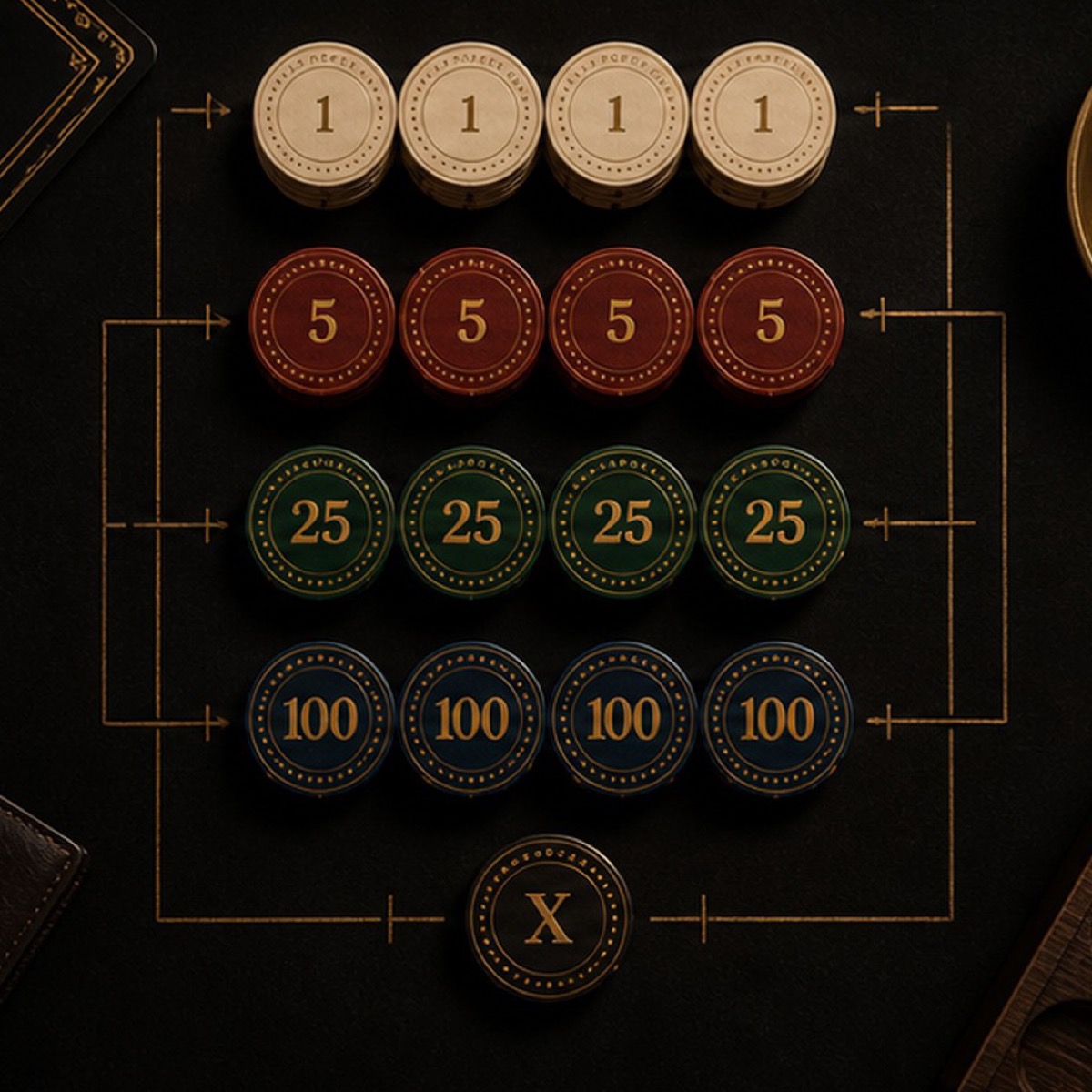
Poker currency is the chip-value system used at the table. In a cash game, chips usually represent real money in the buy-in. In a tournament, chips usually represent tournament points, not cash you can redeem chip by chip. Either way, the host should announce the values before play starts.
What does poker currency mean?
Poker currency is not a separate kind of money. It is the table's shared language for value: which chips count as 1, 5, 25, 100, or another amount, how much each player buys in for, and whether the game is using cash-game dollars or tournament points.
That shared language is what keeps a home game moving. Players can call, raise, count a pot, estimate a stack, and settle up because the chips have an agreed meaning. Without that agreement, a beautiful chip set still creates confusion.
Cash-game chips vs tournament chips
The biggest distinction is whether the chips are directly tied to the buy-in or used only for tournament scoring. Make this clear before dealing, especially when newer players are at the table.
| Format | What the chips represent | Home-game example |
|---|---|---|
| Cash game | Real stake in the game, usually settled against the buy-in. | A $50 buy-in might receive $50 in chips, such as 20 x $1 and 6 x $5. |
| Tournament | Scorekeeping points used for blinds, antes, and elimination. | A $20 entry might receive T$10,000 in chips. Winning T$10,000 does not mean cashing out $10,000. |
| Casual practice | Play-money values used to teach betting without settling cash. | Each player starts with 100 or 200 in chips and plays for practice, food, or bragging rights. |
Should cash be on the table?
For a clean private game, use chips for betting and keep cash off the playing surface after buy-ins are handled. Table-stakes poker generally expects players to play a hand with the stake already in front of them, and public rulesets warn that loose cash can slow play and create settlement confusion.
Home games can be informal, but the principle is still useful: collect buy-ins, issue chips, then let the chip stacks represent the game. If someone rebuys, pause between hands and make the new chips visible to the table.
Common poker currency setups for home games
There is no single universal chip-color system for every private game. The best setup is the one that matches your blinds, buy-in, and player count while keeping stacks easy to count. These are practical starting points for a host.
| Game type | Simple currency map | Why it works |
|---|---|---|
| Micro cash game | 1 = $0.05, 5 = $0.25, 25 = $1.25, or use labeled chips if available. | Keeps friendly stakes low without needing a different set of chips. |
| Low-stakes cash game | 1 = $1, 5 = $5, 25 = $25, 100 = $100. | Easy mental math for $0.25/$0.50, $0.50/$1, or $1/$2 style nights. |
| Tournament night | 25, 100, 500, 1000, and 5000 tournament values. | Supports rising blinds, color-ups, and deeper starting stacks. |
How to announce chip values before play
The announcement should be short and specific. Players need to know the format, buy-in, chip map, blind level, rebuy rule, and settlement rule. Write it down or place a small card near the dealer button if guests are still learning.
Example script: "Tonight is a $20 cash game. White is $0.25, red is $1, green is $5, and black is $25. Blinds are $0.25/$0.50. Rebuys are allowed between hands. Please keep higher-value chips visible."
Stack visibility matters
Poker currency only works if players can estimate it. The Poker Tournament Directors Association recommends countable stacks, often in same-denomination stacks of 20, with higher-denomination chips visible. A home game does not need casino formality, but the same habit prevents mistakes.
- Stack the same denominations together instead of mixing colors randomly.
- Keep the largest chips in front or on top so nobody hides meaningful value.
- Exchange small chips for larger chips when stacks become hard to count.
- Do not change a chip color's value mid-game unless every player agrees.
- Separate the bank or rebuy chips from live player stacks.
How poker currency connects to buying a chip set
A chip set is easier to use when it has enough colors or denominations for the currency map you want to run. For most home-game hosts, the goal is not casino imitation. The goal is enough low chips for blinds and betting, enough mid chips for pots and rebuys, and enough high chips to keep larger stacks manageable.
That is why a 500-chip format is useful for private poker nights. It gives the host more room to support 6 to 10 players, rebuys, and a clearer bank than a smaller casual set.
Where Tells fits
Tells Poker Club is built for private games where the chip set should make the table feel organized, not generic. The first Tells set pairs 500 premium ceramic 43mm chips with cards, a dealer button, and a case, giving hosts a complete setup for defining poker currency before the first hand.
Related reading
For the next setup decisions, read the poker chip denominations guide, poker chip values for home games, and how many poker chips you need.
Sources checked
This guide cross-checks chip-value and table setup guidance against Poker.org's poker chip value guide, the Poker TDA rules on countable chip stacks, and general table-stakes betting conventions. Tells product details come from the Tells Poker Club product context and local product page.